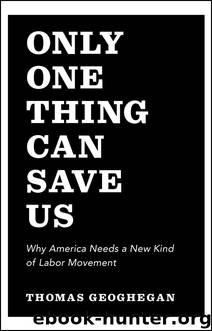
Only One Thing Can Save Us: Why America Needs a New Kind of Labor Movement by Thomas Geoghegan
Author:Thomas Geoghegan [Geoghegan, Thomas]
Format: epub
ISBN: 9781595588654
Publisher: Perseus Books, LLC
8
What Would Dewey Do?
Still, until there is a labor movement, maybe it is up to the schools to save us. For years I scoffed at “school reformers.” Don’t tell me about the schools—let’s change the labor laws. Those people were picking up the wrong end of the stick.
Or so I used to think, but it’s not so simple.
Two centuries ago it was reasonable to believe that the best defense against tyranny or control by a financial elite was public education. Or so Thomas Jefferson believed. It was the way to frustrate the Hamiltonians, the “oligarchs.” For Jefferson, the purpose of education was not to get a job—the kids already had jobs, back on the farms—but to resist the takeover of the country by those on top.
It was to teach them to be citizens: to look the oligarchs in the eye.
Well, of course, the purpose of public education ought to be to help kids get a job. It is to be globally competitive. See? I admit it. But why give up the goal of turning them into citizens?
Perhaps if we went back to the original goal—to teach the young to take part in governing not just the country but their workplaces—we might even be more globally competitive.
It may sound quaint to rattle on about Jefferson or to say the purpose of public education once was to prevent a takeover by the oligarchs. To our ears, Jefferson and his fellow Republicans (still not called “Democrats”) sound paranoid.
But isn’t something like this happening? And here’s what would shock Jefferson: the way the financial elite, the billionaires, are now investing in charter schools to replace the old public education. At the moment, the Hamiltonian elite, the Federalists, are engaged in a buyout of the Jeffersonian project.
Even we labor lawyers who scoff at school reform ought to be alarmed: the schools are being made over to be more user-friendly to a “1 percent” that puts a premium on making sure everyone goes along.
We can ignore Jefferson—he lived a long time ago—but what about John Dewey?
It’s odd given our focus on education that Dewey seems to be in such eclipse. Dewey (1859–1952) was perhaps the greatest American liberal of the twentieth century. For Richard Rorty and others in academia, he is also the greatest American philosopher: our “Angelic Doctor” on the nature of experience, epistemology, and the limits of traditional metaphysics.
But he also thought in practical ways about how children learn in the schools. He thought deeply and profoundly about the problems of education. For Dewey, it had to be democratic: that is, it had to have a political dimension, the very thing it’s missing now.
So if he is our greatest philosopher and if he’s coincidentally the great liberal who wrote profoundly on the ways that children learn, why do we ignore what he has to say?
Well, it’s not entirely our fault. He was a terrible writer. Though he may know what will save us, he has trouble trying to say it. Of one Dewey book, Oliver Wendell Holmes Jr.
Download
This site does not store any files on its server. We only index and link to content provided by other sites. Please contact the content providers to delete copyright contents if any and email us, we'll remove relevant links or contents immediately.
| Anthropology | Archaeology |
| Philosophy | Politics & Government |
| Social Sciences | Sociology |
| Women's Studies |
The Secret History by Donna Tartt(18993)
The Social Justice Warrior Handbook by Lisa De Pasquale(12175)
Thirteen Reasons Why by Jay Asher(8870)
This Is How You Lose Her by Junot Diaz(6854)
Weapons of Math Destruction by Cathy O'Neil(6243)
Zero to One by Peter Thiel(5759)
Beartown by Fredrik Backman(5706)
The Myth of the Strong Leader by Archie Brown(5479)
The Fire Next Time by James Baldwin(5408)
How Democracies Die by Steven Levitsky & Daniel Ziblatt(5196)
Promise Me, Dad by Joe Biden(5127)
Stone's Rules by Roger Stone(5065)
A Higher Loyalty: Truth, Lies, and Leadership by James Comey(4937)
100 Deadly Skills by Clint Emerson(4898)
Rise and Kill First by Ronen Bergman(4757)
Secrecy World by Jake Bernstein(4724)
The David Icke Guide to the Global Conspiracy (and how to end it) by David Icke(4677)
The Farm by Tom Rob Smith(4484)
The Doomsday Machine by Daniel Ellsberg(4472)
